Plumbing problems have a way of showing up at the worst possible time—and the first question most homeowners ask is, “What is this going to cost me?” While exact prices vary by location and job complexity, there are clear ranges and patterns you can use to budget and avoid surprises.
Below is a practical breakdown of typical plumbing repair costs, what drives those prices up or down, and how to keep your bill under control.
Key Factors That Affect Plumbing Repair Costs
Before looking at specific jobs, it helps to understand what plumbers base their pricing on.
1. Service Call / Trip Fee
Most plumbers charge a flat fee just to come to your home, often covering the first 30–60 minutes of work:
- Typical range: $50–$150
- May be higher during nights, weekends, or holidays
- Sometimes waived if you approve a larger repair
2. Hourly Labor Rate
After any included time in the service fee, plumbers usually charge by the hour:
- Typical range: $75–$200 per hour
- Master plumbers and licensed specialists often charge more
- Urban areas and high cost-of-living regions skew to the high end
3. Emergency vs. Scheduled Work
Urgent calls cost more:
- After-hours or same-day emergency service can be 1.5–3× the standard rate
- Flooding, burst pipes, and sewage backups are almost always billed as emergency calls
If possible, scheduling non-urgent work during regular business hours keeps costs down.
4. Complexity and Accessibility
Two repairs that look similar can vary significantly in cost depending on:
- Location of the problem: Behind tile, under slabs, or in tight crawl spaces costs more
- Time to diagnose: Hidden leaks and intermittent issues take longer to track down
- Extent of damage: A small localized leak is cheaper than a system-wide problem
5. Materials and Parts
Your choices impact the final bill:
- Pipe type: PEX can be cheaper than copper; specialty materials and fittings cost more
- Fixture quality: Basic faucets and toilets are much cheaper than designer options
- Brand availability: Common brands are easier and cheaper to repair or replace
6. Permits and Code Requirements
Larger jobs may require:
- Permits and inspections
- Code upgrades (bringing older homes up to current standards)
These add to both labor time and out-of-pocket costs.
Typical Plumbing Repair Costs (By Job Type)
These ranges reflect common prices in the U.S. Your local market, home layout, and specific situation will push costs toward the lower or higher end.
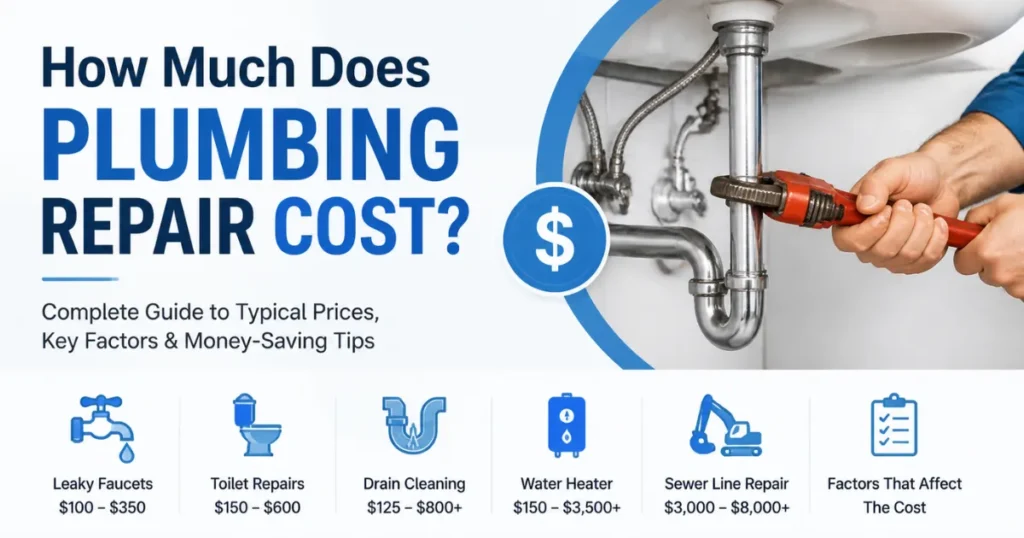
1. Leaky Faucets and Fixtures
- Average cost: $100–$350
- Simple repairs (replacing washers, cartridges, or O-rings) are at the low end.
- Replacing an entire faucet, especially a higher-end model, pushes costs up.
If you already own the new fixture, installation-only jobs tend to be cheaper.
2. Running Toilets and Toilet Repairs
- Basic repairs: $150–$350
- Full toilet replacement: $200–$600 (not including the cost of the toilet itself)
Typical fixes include replacing the fill valve, flapper, flush valve, or handle. Cracked bowls or significant leaks inside the wall often lead to full replacement.
3. Drain Cleaning and Clog Removal
- Standard drain or toilet clog: $125–$300
- Multiple fixtures backing up or main line clogs: $300–$800+
Costs go up if:
- The clog is far down the line
- The plumber needs to remove and reset toilets or cut into walls
- Specialized equipment (like hydro-jetting) is required
4. Burst Pipes and Leak Repairs
- Small, accessible pipe repair: $200–$600
- Extensive damage or multiple leaks: $500–$1,500+
- Slab leaks (under concrete): $1,000–$4,000+
Repairs include:
- Locating the leak (sometimes with specialized detection equipment)
- Cutting and replacing damaged pipe sections
- Restoring access areas (walls, ceilings, or floors)
Remember that water damage restoration (drying, mold remediation, rebuilding) is often a separate cost handled by different contractors.
5. Water Heater Repair and Replacement
Repairs:
- Typical repair: $150–$900, depending on the part
- Common repairs include:
- Thermostats and heating elements
- Pressure relief valves
- Igniters and gas control valves
Replacement:
- Standard tank water heater:
- Installed: $800–$2,000+
- Higher-capacity and high-efficiency models cost more.
- Tankless water heater:
- Installed: $1,500–$3,500+
Installation complexity—venting, gas lines, electrical upgrades—can significantly influence cost.
6. Sewer Line and Main Water Line Issues
- Sewer line repair or replacement: $3,000–$8,000+
- Main water line replacement: $1,500–$4,000+
Factors that push costs higher:
- Depth and length of the line
- Obstacles like trees, driveways, or sidewalks
- Need for trenchless technology vs. traditional excavation
- Permits and inspections
Sewer camera inspections (often $150–$400) are commonly used to diagnose these problems and can help you get accurate bids.
7. Garbage Disposals, Sump Pumps, and Other Fixtures
- Garbage disposal repair: $100–$250
- Garbage disposal replacement: $150–$400+ (plus cost of the disposal)
- Sump pump replacement: $300–$700+ installed
- Shower valve replacement: $300–$800+ (especially if tile must be removed)
These jobs are usually straightforward but can become more expensive when access is difficult or when electrical work is also required.
How to Get an Accurate Estimate
Because online ranges can only tell you so much, it’s smart to get specific quotes for your situation. To get clear, comparable estimates:
- Document the problem clearly
Note when it started, what you see, sounds or smells you notice, and any recent work done. - Take photos or short videos
This helps plumbers gauge complexity before they arrive and may lead to better phone estimates. - Ask what’s included
Clarify:- Service call fee
- Hourly rate
- Estimated time
- Parts and materials
- Cleanup and haul-away
- Get multiple quotes for larger jobs
For anything over a few hundred dollars—especially sewer, water line, and major repipes—get at least two or three written estimates. - Confirm licensing, insurance, and warranties
Legitimate pros should be able to provide:- License numbers (where required)
- Proof of insurance
- Warranty details for both labor and parts
How to Save Money on Plumbing Repairs
You can’t avoid every plumbing issue, but you can keep costs under control.
1. Handle Simple Maintenance Yourself
DIY is often safe and reasonable for:
- Replacing faucet aerators and showerheads
- Cleaning sink stoppers and basic drain maintenance
- Replacing toilet flappers and sometimes fill valves (with careful instructions)
If you’re unsure, ask the plumber which tasks are DIY-friendly for next time.
2. Act Quickly on Small Problems
- A slow drip can turn into a burst pipe.
- A slightly slow drain can become a total blockage.
- A minor toilet leak can damage floors and subfloors.
Dealing with issues early usually means smaller, cheaper repairs.
3. Combine Multiple Small Jobs
If you already have a plumber coming, ask them to:
- Check other toilets, faucets, or exposed pipes
- Inspect the water heater
- Look at any slow drains you’ve been ignoring
You’ll pay one service fee instead of several separate calls.
4. Schedule Non-Urgent Work During Normal Hours
If it’s not an emergency, wait:
- Weekday, daytime appointments avoid premium rates
- Ask about any seasonal specials or discounts
5. Invest in Preventive Maintenance
Annual or periodic plumbing checkups can catch:
- Small leaks
- Corroded shutoff valves
- Failing water heaters
- Early drain and sewer issues
Preventive maintenance is almost always cheaper than emergency repairs.
FAQs about Plumbing Repair Cost
What is the average pipe repair cost?
Average pipe repair costs typically range from $150 to $1,000, with most homeowners spending $300 to $500 for standard accessible leaks. Exposed pipes in basements cost around $150, while hidden pipes behind walls run $150 to $350+. Major repairs reach $5,000.
How much does plumbing diagnostic fee?
A plumbing diagnostic fee, or service call fee, typically costs between $50 and $200, with $100 to $150 being average for a professional to visit and assess the issue. Many plumbers waive this fee if you hire them for the repair.
How much does sewer backup repair cost?
Sewer backup repairs typically cost between $2,000 and $10,000 for cleanup and minor plumbing fixes. Simple clogs requiring snaking cost $150 to $700, while severe cases needing main sewer line replacement range from $5,000 to over $25,000, depending on contamination severity.
What is the plumber’s cost to fix a leaking pipe?
Plumber costs to fix a leaking pipe typically range from $150 to $4,700, with a national average of $500 per repair. Simple repairs under sinks cost $150 to $350, while major leaks behind walls exceed $1,000, with labor at $45 to $150 hourly.
How much does water line leak repair cost?
Water line leak repairs typically cost between $350 and $1,500, with a national average of $1,000. Simple accessible repairs cost $150 to $300, while major repairs involving excavation, such as underground main lines or slab leaks, can exceed $5,000 depending on accessibility.
How much does bathroom leak repair cost?
Bathroom leak repairs typically cost between $150 and $450 for minor issues, with an average of $350. Simple repairs like faucets or toilet seals run $100 to $600, while hidden complex leaks behind shower walls or floors range from $500 to $2,500.
How much does plumbing installation cost?
Plumbing installation costs range from $200 to $1,000 per fixture for minor work, while new construction plumbing costs $8,000 to $20,000 for an average home. Whole-house repiping projects typically range between $1,500 and $15,000, with labor often exceeding $100 per hour.
Final Thoughts
Plumbing repair costs can range from under $150 for a minor fix to several thousand dollars for major line replacements. What you ultimately pay depends on the nature of the problem, how quickly you address it, and the choices you make about materials and fixtures.
Use the ranges above as a starting point, then get clear, written estimates from reputable local plumbers. With a bit of planning and quick action, you can keep your plumbing in good shape and your repair costs as manageable as possible.