1 It Drips From the Spout
A steady drip or a thin trickle at the spout almost always points to a worn cartridge, a scored seat, or a failed O-ring. In San Diego, hard-water scale accelerates all three. A spout drip can waste more than 3,000 gallons a year, so this is the classic case where a small repair pays for itself in water savings. Learn how water chemistry drives the problem in our guide to hard water damage to plumbing.
2 It Leaks at the Base or Swivel
Water appearing at the base of the faucet, around the handle, or where the spout swivels usually means an O-ring or swivel seal has dried out and cracked. This is more than a cosmetic annoyance: the water runs down onto the counter or into the cabinet below, where it can warp wood and feed mold. Left long enough, a base leak can even corrode the mounting hardware.
3 The Handle Is Stiff or Will Not Shut Off
A handle that grinds, is hard to turn, or never quite stops the flow is a cartridge that has been packed with mineral scale. Forcing it damages the valve body. The fix is usually a new cartridge, cleaned and greased with plumber's silicone, which restores smooth operation. If the body is already scored, we discuss a full faucet replacement.
4 The Flow Is Weak or Uneven
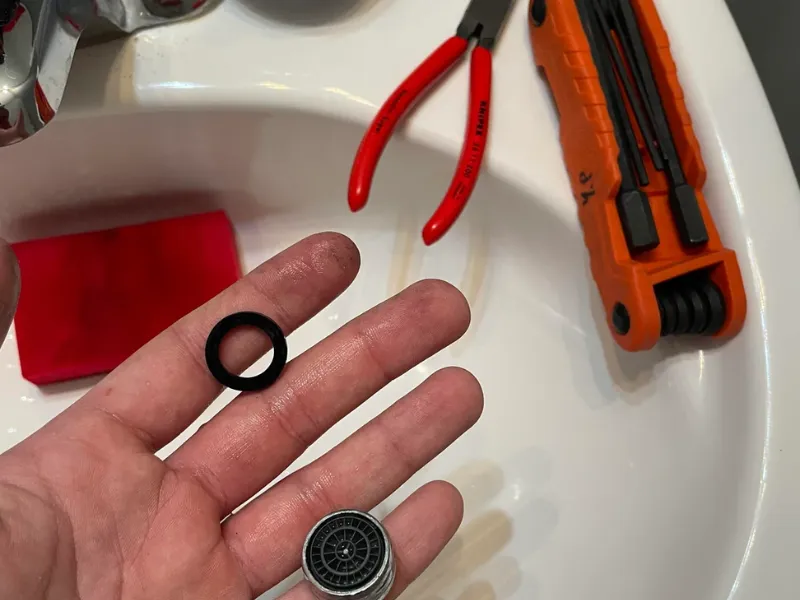
Low flow at one faucet is most often a clogged aerator screen — the tiny mesh at the tip of the spout that traps scale, grit, and debris. We remove and clean or replace it, then check the cartridge and supply lines. If several fixtures in the home are weak, the cause may be larger, which our post on low water pressure in San Diego homes explains.
5 The Sprayer Will Not Switch or Leaks
When a pull-down or pull-out sprayer keeps dribbling in spray mode, or the button no longer diverts, the diverter or sprayhead is worn. On some models this is a replaceable sprayhead; on others the diverter sits inside the faucet body. We identify which part you need and replace only what is required — a common kitchen faucet fix in kitchen plumbing.
6 Water Pools Under the Sink
A puddle in the vanity or under the kitchen sink can come from a failed supply line, a loose P-trap, a corrosion-pitted drain assembly, or an old shutoff valve that weeps. We trace the source with the cabinet empty, repair it, and confirm the fix is dry. This is exactly the kind of slow leak that goes unnoticed until the cabinet floor is ruined — see finding hidden water leaks.
7 The Cartridge Is Seized in the Body
When a cartridge has been scaled in place for years, it can be extremely difficult to extract without damaging the valve body. We use the correct puller and penetrant, and we work carefully so the faucet can be saved. If the body cracks during removal, we have replacement options ready, so you are never left without a working faucet.
8 The Finish Is Pitted or the Spout Is Cracked
Once the finish starts pitting, flaking, or corroding, the faucet is telling you the metal underneath is failing. A cracked spout or a corroded body cannot be repaired reliably. In these cases replacement is the right call, and we help you choose a faucet suited to San Diego's hard water. Our plumbing repair cost guide covers what to budget.